
| About | Membership | Volunteer | Newsletters | Souk | Links |
Virtual Magazine of Morocco on the Web
Morocco Week in Review
April 5 , 2014
فوج جديد من "كتِيبة السّلام" الأمريكيّة يستعدّ للتطوّع في المغرب
Swearing in Event on hespress (a highly consulted online news site) in Arabic:

هسبريس - طارق بنهدا
الجمعة 04 أبريل 2014 - 19:00
بعد أن أنهوا ثلاثة أشهر من التدريب المكثف رفقة أُسَر مغربيّة لتلقّي اللهجة الدّارجة، أدى 101 متطوعاً ومتطوعة قدِموا من مناطق مختلفة من الولايات المتحدة الأمريكية، وينتمون لهيئة السلام الأمريكية، القَسَم الجماعي إيذانا بانطلاق الفوج الجديد للعمل التطوعي في مناطق ومدن مغربية مختلفة.

الفوج الجديد من كتيبة السلام، الذي سيعمل لمدة سنتَيْن بالمغرب، تم تقديمه اليوم بالرباط، خلال حفل ترأسه وزير الشباب والرياضة، محمد أوزين، ووزير الخارجية الأمريكية جون كيري، الذي أثنى في كلمته على العلاقات المغربية الأمريكية، مخاطبا المتطوعين الجدد بالقول إنهم "في المغرب لتمثيل أمريكا"، و"أنتم فاعلون من أجل التغيير عبر العالم".
كيري، تحدث في كلمته عن مدى إسهام برنامج "هيئة السلام الأمريكية" في تعزيز قيم السلام والصداقة والتسامح عبر العالم، مشيرا إلى أن برنامج متطوعي الهيئة بالمغرب يعد فرصة لـ"تعلم الكثير وتعزيز علاقات الصداقة بين المغرب والولايات المتحدة الأمريكية".

ويقوم وزير الخارجية الأمريكي، جون كيري، بزيارة رسمية تمتد ليومَيْن للرباط، حيث ترأس صباح اليوم الجمعة، إلى جانب صلاح الدين مزوار، وزير الشؤون الخارجية والتعاون، أشغال الدورة الثانية للحوار الاستراتيجي بين الرباط وواشنطن، تحت شعار "تعزيز علاقات التعاون المتينة بين البلدين".
أما محمد أوزين، وزير الشباب والرياضة، فأشار في كلمته التي وجهها إلى المتطوعين الأمريكان، إلى أن برنامج "هيئة السلام الأمريكية" يعد آلية ضمن أخرى ترمي "تعزيز روابط الصداقة والتعاون بين المغرب والولايات المتحدة الأمريكية"، مشددا على أن المغرب اهتم بجانب الشباب كأولوية تهم السياسات التنموية.

ويُعدّ المغرب من البلدان الأوائل التي استدعت "كتائب السلام"، بطلب من وزارة الخارجية والتعاون، وذلك في سنة 1963 حيث وصل أول فريق من المتطوعين، المكون من مدرسي اللغة الإنجليزية وخبراء الري.. في وقت بلغ فيه مجموع المتطوعين في إطار هيئة السلام بالمغرب أزيد من 4 آلاف شخص على مدى 51 سنة.

وسيتم تعيين كتيبة السلام الأمريكية المتطوعة ضمن وزارة الشباب والرياضة، بالاندماج في 80 مؤسسة، بما فيها دُور الشباب وبعض المراكز السوسيو رياضية للقرب ونوادي النسوة بمختلف المدن المغربية.

وسيعمل المتطوعون في عدة مجالات، أبرزها تدريس اللغة الانجليزية والتوعية الصحية والبيئة، وهندسة المتنزهات وتنميّة المقاولات الصغرى، إضافة إلى الإمدادات بالمياه الصالحة للشّرب في العالم القروي وتنمية قدرات الشباب.

ومن وجهة نظر "هيئة السلام بالمغرب"، فإنها تتوقع على مدى 5 سنوات القادمة أن يقوم الآلاف من الشباب المغربي بالانخراط بشكل إيجابي، بعد تأهيلهم في ولوج سوق الشغل والمشاركة في الحياة الأسرية والوسط الاجتماعي.
Video here: http://www.hespress.com/videos/175861.html
--------------------------------------------------
Peace Corps Swearing-in Ceremony
Imperial Valley News Friday, 04 April 2014 Written by State Department Rabat, Morocco
Secretary of State John Kerry: "Chris, thank you very much. Thanks for your service, and thank you for the introduction. And Minister Ouzzine, it’s a great pleasure to be here with you. Thank you very, very much for being part of this. And all of our guests, distinguished guests - oh, there’s President Kennedy over here. I’m just looking over there.
"This is really cool. I want you to know I’m really excited about this. I’m thrilled that somehow it coincided and we were able to work out that I have the privilege of swearing you in. And when I heard I was swearing in 101 Peace Corps volunteers, I immediately thought of 101 Dalmatians. (Laughter.) I couldn’t help it. Sorry about that. That has nothing to do with anything, all right? (Laughter.) And you certainly don’t think of yourselves that way.
"There are a lot of reasons why this is special. I am old enough to have been old enough at the time that it meant something to me when President Kennedy made the announcement about the Peace Corps and appointed his brother-in-law Sargent Shriver to be the first head of it. And I remember that very distinctly, the sense of excitement. I had the privilege of meeting President Kennedy, because I was then 18 years old and just out of high school, working full time for somebody who was to become my colleague, Senator Ted Kennedy, then a candidate for senator in Massachusetts. And I was just a kid in the summer, and I happened to be in a place where the President was during that period of time. And we chatted a bit, and he chastised me for my choice of college, but – (laughter) – he was very funny about sort of the commonality of some of the interests at any rate. And he made an impression on me – a lifetime-lasting impression.
"And the Peace Corps itself has always embodied really the best aspirations of America in terms of our reach in the world – our efforts to help people to do better in life, our efforts to try to create stability and opportunity and prosperity, our efforts to give people a sense of what makes a difference in terms of the values which will guide them as they grow and become, hopefully, public citizens themselves at some point in time. And so your willingness to stand up and say, “I’m going to serve,” in this capacity is really, really special, particularly at a time when so many people are sort of pressured and enticed towards a more lucrative undertaking, particularly in their immediate post-college years, where you’re saddled with college debt and other career pressures and choices.
"You’re joining one of the proudest traditions that there is. As Chris mentioned, the 5,000-some people who have served here, it includes Ambassador Chris Stevens, whom we lost, as you all know, in Benghazi. It includes a fellow by the name of Ambassador Robert Ford, who has been our special – really, he’s been the ambassador to Syria, but because he hasn’t been in Syria, he’s been our special envoy, so to speak, to the Syrian opposition, and has worked diligently these past years to be able to help the people of Syria do better. But his commitment began right here, like yours. Ambassador Richard Holbrooke, one of our distinguished diplomats, a man who went on to help broker peace accords at Dayton and dealt with so many difficult issues, began as a Peace Corps volunteer.
"So you’re following in the footsteps of accomplished, distinguished diplomats who made a difference as they went on in life, and I’m confident that you will, those of you who choose to go on in that way. And I have no doubt that perhaps sometime in the future, when a next secretary is standing up and swearing people, one or more of your names will be the examples that will then be given to people.
"You’re joining the Peace Corps at a very, very important time. I can’t emphasize enough to you how critical it is. And obviously, it has its challenges. The world is changing unbelievably rapidly. And to some degree, that’s creating the counterforce that we see in certain places. It’s a reaction against modernity, against change, against the invasion of the rest of the world into people’s lives because of the media and because of communication that’s sometimes unwanted and unwitting.
"And so whether you like it or not – and we talked about this in our security dialogue a few moments ago with our Moroccan friends – that everything that’s happening everywhere invades everywhere all the time. And the result of this is a sense of invasion, really, of sometimes unwanted values, unwanted principles. And it forces a transition, no matter what. So in places that are particularly tribal or particularly insular, and where there’s a more conservative strain, that can be difficult. And we have to acknowledge that. We have to honor that. People need to be able to do things at their pace and in their way, but still, we have to remain committed to fundamental values – freedom, human rights, democracy, and tolerance, things that you will be practicing and teaching every day in your efforts as Peace Corps volunteers.
"And when you look at the population of Morocco, it’s really a reflection of what is happening in the rest of the world – 60 percent of a population under the age of 30, and 50 percent of the population under the age of 25 – 50 percent. That’s a lot of jobs to find and create. That’s a lot of educating to do. That’s a lot of opportunity to create. So it’s a big task. It’s a complicated world. And I admire enormously those who have chosen to go out into this world and help to make a difference.
"Now, I will tell you that what you do could help shape the economy of this country in the future. It will certainly shape lives. Individual lives will be touched by the multiples for those people that you come into contact with and make a difference for. And it seems to me that this is what makes this adventure you’re about to embark on so meaningful, is that when you help a young Moroccan develop a skill to be able to build their community or to build their own career, when you help somebody to learn English or help somebody to start a business or to learn some valuable lesson as simple as playing sports and being a part of a team, you are investing in a safer region and a stronger world.
"So the 101 of you are going to match your diverse talents with your expertise, and you’re going to go out there and have an opportunity to be able to learn a lot about the perspectives of the young men and women that you’re going to meet. And as you do, you’re going to strengthen the friendship between Morocco and the United States, a friendship that is older than the Constitution of the United States of America. I remind you that Morocco was the first country in the world to recognize the United States in 1777.
"So before I ask you to join me up here on the stage to take the oath, I just want to leave you with one reminder and perhaps one prediction. The reminder is this: In every intersection that you have with any individual Moroccan, anyone you meet, you may be the only American that that person has met that day, that week, that year, perhaps, or that lifetime. So you represent the United States in every single thing that you do. And I ask you to remember that the ambassador who is presenting his credentials today may have the fancy title of ambassador, but every single one of you are an ambassador. And that was something that Sargent Shriver said more than 50 years ago when he returned from Africa at the beginning of this journey. He said that the manner in which volunteers carry out their work is just as important as the quality of their work. And believe me, that is still true today.
"So that’s my reminder. My prediction is this: You’re going to find that this journey means as much to you as it will mean to the people and the communities that you’re going to serve. It goes both ways. That’s the beauty of it. And in the same message that I just mentioned Sargent Shriver gave when he came back from Africa, you know what he said? He said, “Go in a spirit of humility, seeking to learn as much as to teach.”
"So I’ve got every bit of confidence that you all are going to do that. It’s my honor now to administer to you the very same oath that I took, the very same oath that the President takes and that all of us have taken since the time of George Washington. So please, if you will join me up here on the stage, I will deliver your oath that will make you official Peace Corps volunteers." ~ John Kerry
http://www.imperialvalleynews.com/index.php/news/world/7970-peace-corps-swearing-in-ceremony.html
--------------------------------------------------
The Call to Prayer Viewed by an American.
By “PCV” Tara Waters Monday 31 March 2014 Boumalne Dades, Morocco
The call to prayer is an experience unlike any other. It is a unifying experience to have something that reminds a country to stop, reflect and thank a higher power for all that has been given to them. In the last few years I have lost my faith in organized religion, but there is something about the call to prayer that gives me chills.
For the next two years I will be immersed in the Islamic faith, a religion I unfortunately know very little about. My excitements for discovery are high, both intellectually and spiritually. Perhaps that is why I find the call to prayer so enchanting. As the sounds echo across the city, I am reminded of the vast ways I will change and of the many things I will learn throughout my two years here in Morocco.
I have traveled to other African nations before and have done a large amount of research on the various others, but I never took the time to study Morocco. As an African nation, it stands out greatly from the rest. Many if not all people would categorize Morocco as part of the Middle East. As I get to know the country better, I find it hard to classify Morocco as either African or Middle Eastern. In my opinion it holds elements of both, yet distinctly sets itself apart from either of them.
Only time and further learning will help me to understand just what Morocco is and possibly I will never find the answer. As I reflect back on my first month here, I see Morocco as an individual, a country strong in pride, religion, tradition, and history.
The call to prayer will always remind me of Morocco’s strong Islamic pride and practice, but my everyday interactions will forever teach me of Morocco’s individuality and diversity.
Organized religion may not be something I agree with or hold strong pride in, but during my time here, I will take the time to learn and understand the Islamic faith. I think it is a powerful experience to be immersed in a life far from my own. The call to prayer reminds me every day of my immersion, reminding me to stop and take a second to thank the world for giving me the opportunity to experience such a rich and diverse culture.
There will always be things in this world that I do not agree with, and there will be many things in my own life that others do not agree with. The important thing is the understanding and acceptance of that difference. Diversity is something to be celebrated, and if we can manage unity without uniformity, then we have truly achieved what it means to be human.
Someone once told me the five secrets, in her opinion, to living a happy life. The two that will forever stick in my mind are,: everyone disappoints and always protects your heart. Before fights are fought take a moment to realize that everyone messes up and does wrong. Perhaps what is needed is a good conversation rather than fists of rage. Let’s be honest, nothing good comes from fighting only broken hearts and sometimes even the loss of life.
Everyone deserves the chance to be heard and understood. We may not agree, but if we take the time to step back and see the meaning in their words, then perhaps we can grow together and make a change that will create a brighter future.
http://www.moroccoworldnews.com/2014/03/127040/morocco-the-call-to-prayer-viewed-by-an-american/
--------------------------------------------------
Moroccan Culture and Islam: A Tale of American Integration
By ‘PCV’ Peter C Smith Wednesday 2 April 2014 Ksar El Kebir, Morocco
Serving as American volunteers in Morocco, my wife and I were give a priceless gift. That gift was the ability to see and experience another culture without the blinders of someone else’s views distorting our own. As volunteers, we are routinely required to complete reports on mission progress, future goals and current status. In our last report, we were asked a question about our integration into our current community. What follows is the question posed and my response:
“How integrated do you feel in your community?”
While this question, on the surface, seems relatively simple, nothing could be more removed from the reality of it. To begin to answer this question honestly, I must first decide what integration means, subjectively, to me. After all, it is my question and my answer to give. To determine how to respond, I only have my previous community “integration,” from the United States, upon which to base my answer. I will use comparisons to illustrate my current view of my position and situation in my community of Ksar El Kebir, Morocco.
In the US, I lived a very “normal” and somewhat privileged life. As lawyers, my wife and I worked hard and were well known throughout our city and the legal community. We went once or twice a week to the grocery store for food and sundries and we would socialize with friends on the weekends, provided it was convenient to all parties. We lived routine lives divided between work and the weekends. When it came to our families, who happened to live relatively close by, we would only speak to them once or twice a month and usually on Facebook or through a phone call. Our logistics included driving everywhere in our city, even though the local store was only 3 blocks away. We lived in a house with neighbors that both of us knew by name but with which we spoke rarely, if at all. When my wife and I vacationed, we would always choose to do so abroad and rarely with family or friends. This describes the situation that is my basis for comparison and a life which many in the US strive to achieve.
Many may describe our former situation as the “American Dream” realized. However, as “integrated” into our community as we thought we were, we were, in hindsight, nothing more than cogs in a very large and somewhat dysfunctional machine. I believe my comparisons shall make this point clear.
Upon arriving in Ksar El Kebir, Morocco, we were, for better or for worse, instantly singled out as outsiders and looked upon with suspicion and skepticism.We were “those” people who did not belong and were the scuttlebutt of the town. However, through constant personal interaction with virtually everyone we came into contact with, be he/she a beggar or a city council man, a young man or an old woman, we became a constant and visible presence in Ksar. Daily perseverance, endless kilometers walked and unending smiles later, we have reached a point in our social and community standings that has redefined our personal beliefs as to what it means to be “integrated,” and furthermore, what it means to be happy.
As before, in the US, we are now known in our community but this time it is because people actually know us and for the reasons stated above, love and adore us. We have shelved the titles that come with degrees in exchange for something far greater, the titles of Kareem and Miriam. These people, Kareem and Miriam, are beloved and participating members of the community. Where we once enjoyed the convenience of “food supermarkets” once or twice a week, we now have loving friends, who just happen to own carts or hanuts (small stores) that we visit daily. Even before we make our requests for purchases, we are asked about our health, happiness and even our families back in the US.
These are people who know, more often than not, what we want, what we like and are very happy to share with us what they think we will like or need; whether it is how to properly prepare harira or just a new vegetable we have never tried. And, the true beauty of this type of relationship is that each and every one, with whom we deal, absolutely has our best interests at heart and not just the prospect of selling us “stuff” and making a profit. We see Driss, our dear old butcher that saves the “special” selections of meat for us under the counter.
We have Fatima, our motherly vegetable cart woman who would NEVER let us pick the “iffy” produce and laughs every time my wife holds out a hand full of change so that she may take what is due her, at the same time admonishing Miriam for doing so. There is M’hammed, our sole source of fresh squeezed orange juice, who once left his cart just to walk us across town because we needed a pressure cooker and he wanted to ensure we got the “best” one. (And, no, the money was not such that he would have made enough from a kickback to warrant leaving his prosperous and lucrative business.) And of course, there are the brothers (twins) Atta Allah: Charif and Achraf, who, while apart from being very successful business owners in Ksar having both a farm and very popular restaurant, just happen to be two of the best friends I have personally ever had.
These connections and friendships beg to be compared to those I previously had in the US. Unlike my US friends, there is a level of caring, kindness and concern that comes naturally from Moroccans and it is unlike anything that I have ever shared or experienced before in my adult life. If I am sick, there is a flurry of rapid inquiries from one end of the town to the other. Offers of food, prayers and medical remedies, some of which involve interesting uses of raw garlic, come at a blistering pace. By contrast, in the US, if I don’t see my friends for a week or so, no one thinks anything about that length of time. After all, why should they, it’s only a week or two. Here, if more than a day or two passes with no sight or word from us, the town begins to worry and the phones begin to ring, the door begins to seem more like a drum than a door and Facebook is flooded. While this much attention is a double edged sword, it is quite a comforting feeling to receive such affection from so many people and we consider it a blessing.
Socializing has also been redefined here in Ksar for both my wife and me. We are constantly being invited to this gathering or that but gone are the nights full of wine, cocktails and constant talk of work. What has replaced our former social gatherings is like nothing that we would have ever dreamed. There is no such thing as a “small” get together with a “little” food. Gone are the “strangers” that we don’t know and in their places are friends we just haven’t met yet. And, the term late night has been completely redefined from 11:00pm to “when there is no more party.”
Holidays are another area where our ideas of “normal” integration have been completely turned upside down. In the US, especially at Christmas, Easter and Thanksgiving, we will be cordially invited to someone’s gathering or dinner but these invitations, while often genuine, do not always carry near the heart felt attachment to them that those in Morocco do. During Ramadan, Eid Kebir, Ashara and every wedding, birthday and couscous in between, we are bombarded with invitations that, should we refuse, would actually cause someone pain. It is only because the invitations come from such a caring place that we have the power to deeply hurt someone’s feelings. If this close connection is not a sign of considerable social “integration” than I am not sure what else could be.
As for family, I have never seen a community that rallies more honestly and deeply around the family unit as I have witnessed and become a part of here in Ksar and in fact, all of Morocco. It is truly an amazing feeling the day you realize that you are no longer someone who lives in the neighborhood but that you have become part of a large family that just happens to live together in a neighborhood, town and by extension, a country. With that realization comes a very comforting and yet humbling feeling. When that day arrived for us, we knew that we were no longer foreigners living in Hay Andelous (our neighborhood) but part of a loving, caring and EVER watching family that included many, many people and businesses. People in the US often ask us if we ever have fears living in Morocco, a Muslim country, to which we simply reply, “Why would we? We live among some of the most loving, caring and wonderful people in the world.”
The original question was, “How integrated do you feel in your community?” The very simple answer to that not so simple question is that we have not integrated into a “community,” but rather, we have simply become part of a very large family. Hamdullah.
The views expressed in this article are the author’s own and do not necessarily reflect Morocco World News’ editorial policy
http://www.moroccoworldnews.com/2014/04/127204/moroccan-culture-and-islam-a-tale-of-american-integration/
--------------------------------------------------
Success of INJAZ-Morocco’s Entrepreneurship Masterclass
Sunday 30 March 2014 By “PCV” Courtney Haueter - Zaio, Morocco
On Friday, March 28, 29 students successfully completed INJAZ-Morocco’s Entrepreneurship Masterclass workshop at the Dar Taliba in Zaio. The workshop, which was for women, began on the evening of Thursday and continued Friday afternoon. The workshop was designed to familiarize Morocco’s youth with the world of entrepreneurship and develop their skills and talents.
INJAZ-Morocco is a non-profit association that works with the private sector on behalf of the youth to help a growing and newly emerging generation of entrepreneurs. Established in October 2007, INJAZ Morocco is a member of Junior Achievement Worldwide, which has been involved in entrepreneurship education since 1919.
Mr. Abdelaziz Askitou, a youth development volunteer and a facilitator at the workshop said that “Youth development implies that efforts should be made to help young people develop the necessary skills and competencies that will help them function effectively in their lives. Therefore, one of the main goals behind the Entrepreneurship Masterclass workshop is to engage Moroccan youth in thinking about their business ideas by providing them with information about what it means to be a successful entrepreneur.”
The primary objectives of INJAZ-Morocco’s Entrepreneurship Master workshops are to help the participants understand business challenges, acquire key entrepreneurial skills and attitudes, and test their entrepreneurial skills and strengths.
“It seems almost axiomatic that the development of organizational skills among young people will contribute to the development of both character development and community development.” To that end, “Moroccan youth need to be equipped with the necessary tools, mechanisms and strategies that would help them become able to accommodate themselves to meeting the relentless changes taking place in today’s world. To succeed in this, the development of managerial and entrepreneurial skills among Moroccan youth then becomes a key issue,” Mr. Askitou stated. http://www.moroccoworldnews.com/2014/03/126951/success-of-injaz-moroccos-entrepreneurship-masterclass/
--------------------------------------------------
Joint Statement of the Second Session of the United States - Kingdom of Morocco Strategic Dialogue
At the second session of the United States-Morocco Strategic Dialogue today at the Ministry of Foreign Affairs and Cooperation, Foreign Minister Dr. Salaheddine Mezouar and Secretary of State John Kerry built on the substantial and ambitious roadmap agreed to by His Majesty the King Mohammed VI and President Obama in Washington in November 2013, pledging to use our strong strategic partnership to advance shared priorities of a stable, democratic, and prosperous Maghreb, Africa, and Middle East.
Support for Democratic Reforms
The Secretary reiterated the United States' appreciation for the action and the leadership of His Majesty the King in deepening democracy and promoting economic progress and human development during the last decade. In this context, the Minister and the Secretary discussed the ongoing implementation of Morocco's 2011 constitution and how the United States can support the strengthening of Morocco's democratic institutions, civil society, and a culture of human rights. The Secretary welcomed the Government's endorsement of a law eliminating military tribunals for civilians, another important step in implementing His Majesty the King's vision of Morocco that conforms to international norms and best practices with regards to human rights. The Secretary also noted the United States' Government's continuing interest in the outcome of Morocco's National Dialogue on Civil Society and the development of an enabling environment for dialogue between government and citizen. The Secretary commended the Minister for Morocco's continuing efforts to implement sweeping changes to its asylum and immigration system, with positive implications for legal and illegal migrants, refugees, and asylum seekers. The two parties reaffirmed their intent to work together to promote human rights globally at the United Nations Human Rights Council.
Economic Cooperation
The Minister and the Secretary discussed the benefits of maintaining an attractive business climate for investment in Morocco. They acknowledged the concrete measures undertaken by Morocco to become eligible to join the Open Government Partnership, the importance of Morocco as a trade and investment platform for North and Sub-Saharan Africa, and United States' support to improve the quality and relevance of Morocco's basic education. They lauded the signing of a $38 million agreement to provide Moroccan youth with the workforce development tools for a better transition from education to employment. They discussed the recently concluded Second United States-Morocco Business Development Conference, which strengthened business-to-business ties in the service of expanding trade and capitalizing on the United States-Morocco Free Trade Agreement, promoting investment, collaborating on energy issues, and encouraging regional economic integration through the establishment of effective partnerships. Both parties look forward to Morocco's hosting the 2014 Global Entrepreneurship Summit before the end of this year and the important opportunity that represents to build a culture of entrepreneurship to create employment opportunities for youth across the region. They welcomed the positive preparatory work for a 2nd Millennium Challenge Corporation compact……
More here: http://allafrica.com/stories/201404041065.html
Or here http://www.albanytribune.com/03042014-morocco-us-second-strategic-dialogue-time-win-win-partnership%E2%80%8F-oped/
--------------------------------------------------
Gender inequality and the recent reforms of Moudawana in Morocco.
Thursday 3 April 2014 Fez
After many years of struggle by women’s organizations, the situation of women in Morocco has improved, thanks to the adoption of several reforms.
During the last two decades, Moroccan women have been calling for equal rights between men and women. Their efforts have given birth to many triumphs and contributed to the improvement of the status of women in Morocco. Theoretically, Morocco has some of the most improved laws for women’s rights in the Arab world. However, these new laws are not applicable throughout Morocco, especially in rural areas.
Starting from the 1990s, women’s struggle for reforms achieved a concrete victory and began to gain momentum. Conducted by the Union of Women’s Action (UAF), a petition calling for the reform of the Personal Status Code and Sharia-based family law collected signatures of one million women. This petition demanded the government to sign the UN Convention on the Elimination of All Forms of Discrimination Against Women (CEDAW), and to use its articles to amend the country’s Moudawana (the official family code that dictates the roles and relationships between men and women within the family). Consequently, Morocco ratified the CEDAW in 1993, but with a number of reservations. Moreover, during the last decade, the Moroccan government introduced more reforms to the Personal Status Code.
The terrorist attacks in Casablanca in 2003 represented an opportunity for the Moroccan government to reform the Moudawana, in spite of the objection of the Islamist leaders and the accusations that the king introduced these reforms under pressures from the European Union and the United States. Despite the fact that the reforms scored a victory for the Moroccan women movements, Islamists, including women, strongly opposed those reforms. The spokeswoman of Justice and Charity Islamic Movement, Nadia Yassine, described the reforms as representing the interests of foreigners and international feminist movements, rather than the legitimate will of the Moroccan people.
The reformed version of the Moudawana grants men and women equal rights within the family. Husbands and wives now have equivalent rights in house management, family planning, children upbringing, and legal cohabitation. The legal minimum age for marriage for both men and women is 18 years (it was previously 15 years for women). Special cases of marriage under that age now require permission from a judge. Also the free consent of both spouses is now required by law and women no longer need permission from a male guardian to marry.
The Moudawana does not entirely prohibit polygamy, but rather includes measures that make it very complicated. Those who want to marry another wife must obtain a judge’s permission and provide a documentary evidence of their financial situation. They must also certify that all their wives will receive equal treatment, and that their first wife (or wives) has given her approval. Since the reforms were introduced, the number of new polygamous marriages has decreased. Furthermore, the new family code eradicated the concept of repudiation (that is to say, the husband’s right to unilaterally divorce his wife) and gave women the right to divorce on the same grounds as men.
Morocco further amended the Family Code in 2007 by passing the Nationality Code, which granted Moroccan women married to foreigners the right to pass on their citizenship to their children. In the past, only fathers possessed this right.
Dr. Khalid Bekkaoui recently conducted a survey on 1,271 respondents who belong to different parts of Morocco. When asked their opinion about the Moudawana, the respondents’ answers were as follows:
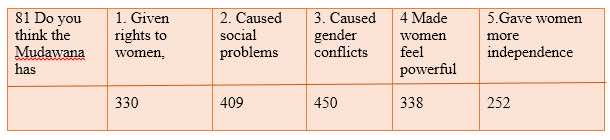
The answers do not show big differences, but they show that the majority of respondents do not have positive opinions about the Moudawana. They think that it has caused gender conflicts and social problems. However, a significant number of respondents, about one third, have positive attitudes towards the Moudawana, stressing the fact that it has given women more independence and made them more powerful. The large number of respondents who have negative opinions about the reforms of the Moudawana could be related to the fact that Morocco is still a patriarchal society, which refuses to reach equality between men and women. Women in the countryside are subordinated to their husbands and fathers; they have no agency. They are not even aware of their legal rights. The majority of them have no idea about these reforms.
In other questions about whether respondents think that women can be efficient political leaders, efficient ministers, and whether they can issue fatwa, the majority of the respondents (around two thirds) responded with “yes”. That is to say, they think that women can be good political and religious leaders. The following chart shows their answers:
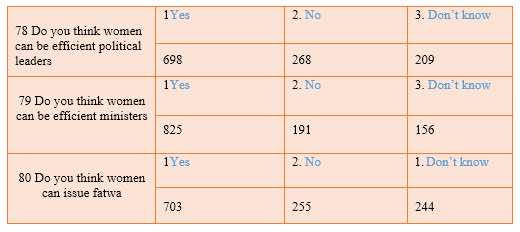
This shows that Moroccans have positive opinions about women; they think that women, like men, can be good leaders. However, some Moroccans, as the survey shows, have negative opinions about the reforms of the Moudawana. They probably think that the Moudawana has deviated from religious teachings concerning the relationship between men and women and the reforms of the Moudawana have deprived men from some of the rights that religion has given them. Another reason could be related to the fact that some people (especially Islamists) think the reforms of the Moudawana were imposed by Europe and the U.S. , and therefore serve external agendas.
When the Arab Spring reached Morocco, the February 20 Movement, which led the protests against the Moroccan political system and demanded reforms from the part of the King, included several women activists. In March 2011, the Government Agenda for Equality was ratified, and on June 17, King Mohamed VI expressed support for a constitutional reform that would enhance the separation of powers in government and support gender equality. The referendum outlining these reforms took place on July 1, and passed with 98% of the Moroccan electorate. The new Constitution prohibits gender based discrimination and adopts new laws that reinforce gender equality in fundamental rights and freedoms.It offers protection of individual rights and gives special recognition to women’s rights. Article 19, for instance, entitled “Honor for Moroccan Women,” makes men and women equal citizens under the law; specifically, it grants men and women equal social, economic, political and civil rights. It also created the “Authority for Equality and the Fight Against All Forms of Discrimination,” charged with the function of putting into practice the constitutional recognition of equal rights. For the women’s rights movement, at least on paper, this event represented a long-awaited realization of twenty years of activism.
While these major reforms have been applauded by feminists in Morocco and other countries, women’s movements are still working hard to ensure the implementation of these reforms throughout the different parts of the country, and to call for additional legal changes. Recently, ADFM (Association Democratique des Femmes du Maroc) launched the campaign “Equality Without Reservation,” a regional campaign to compel the government to respect all the rights enshrined in the CEDAW. The biggest challenge to the women’s movements has been the inability to integrate these reforms throughout the country.
So although the Constitution has allowed some progress in theory, there hasn’t been much difference in practice, especially in rural areas. The ongoing obstacle of women’s illiteracy implies that a substantial number of Moroccan women are unaware of the efforts being waged on their behalf by their educated and mobilized counterparts, and they remain oblivious to their newly gained rights.
http://www.moroccoworldnews.com/2014/04/127352/gender-inequality-and-the-recent-reforms-of-moudawana-in-morocco-2/
--------------------------------------------------
With Fulbright grant, Meriden teacher hopes to develop ‘culturally responsive’ curriculum
By Molly Callahan Record-Journal staff April 4 th, 2014 MERIDEN
A Washington Middle School teacher will take a trip to Morocco this summer after winning a Fulbright scholarship. Sarah Stolfi, a social studies teacher at Washington for nine years, said she was intrigued by the University of New Haven grant that will allow her to travel to the North African country. “It turns out that one of the things they emphasized was a ‘global classroom,’ and I like to think I already have that going on,” Stolfi said.
Stolfi will travel with 11 others in July to participate in UNH’s Global Classrooms and Cultural Connections for the 21st Century Learners: Morocco’s Bountiful Perspectives program. She plans to use the experience to develop a curriculum that’s “culturally responsive,” focused on breaking down stereotypes and “bringing that knowledge back to the students of Meriden.”
Associate Superintendent Robert Angeli said that “only a handful” of Meriden teachers have been part of a Fulbright program in the past few years. “It’s a prestigious award for educators, and we’re very pleased that she’s been awarded the scholarship,” he said.
It wouldn’t be the first time Stolfi, who heads Washington’s social studies department, has brought experience from other countries into her classroom. She teamed up with the school’s media center specialist this year on a program called “ePals,” which connects students and teachers from different countries in a pen-pal network. Her students have ePals in France, Italy and England. Stolfi is working on a partnership with a school in Pakistan.
Though language might have been a barrier to the ePals, Stolfi selected overseas students learning English as a second language. Plus, “they all speak ‘teenager,’ ” she said. “We’ve been able to form an amazing partnership, and to see their faces when they know they’ve gotten mail from one of these schools is great,” Stolfi said.
It’s that sort of collaborative learning that Stolfi hopes to continue with help from her Fulbright experience. “The ability to bring back to Washington Middle School a Moroccan experience — that’s the goal,” Stolfi said.
Stolfi said the curriculum she develops based on her stay in Morocco will focus on the similarities and differences between cultures. “I’d like to get a handle on it myself,” she said. “Learn about how they live their daily lives, their attitudes and perspectives on things.”
Aiding in that discovery will be the opportunity to stay with a Moroccan family for a while, right after the end of Ramadan.
As part of their preparation, Stolfi and her peers will learn Arabic, a process they’ve already started. “I’ve already learned some consonants,” Stolfi said, “but you’re reading from right to left. It’s hard to train to your brain to go backwards like that, although I hope by the end to be able to read and even print in Arabic.”
Angeli said, “Teachers who immerse themselves in the subject matter the way she’s doing can really bring it alive for the students. Having Sarah go to Morocco will be an enriching experience for her, but just as great is that it should lead to some exciting opportunities for our students.”
For her part, Stolfi said that she expects to return with plenty to share. “One celebration isn’t going to be enough for me,” she said. “The trip isn’t just for me,” Stolfi said. “I want my other social studies colleagues to be able to utilize the resources I’ve found, and tips I’ve collected on how to create a global classroom.” mcallahan@record-journal.com (203) 317-2279 Twitter: @MollCal
http://www.myrecordjournal.com/meriden/meridennews/4082799-129/with-fulbright-grant-meriden-teacher-hopes-to-develop-culturally-responsive.html
--------------------------------------------------
Corps Africa: An Opportunity for Moroccans to Heighten the Notion of Volunteering.
Sunday 30 March 2014 Mona Badri
Being a former Peace Corps volunteer in the High Atlas, Liz Fanning feels the Moroccan drums beat so hard in her heart, bringing her back to a land that earned her love and respect. In 2013, she launched the first pilot year of CorpsAfrica in Morocco, modeling it after the American Peace Corps volunteering program.
The notion of volunteering has always been associated with Americans who come to Morocco and serve for two years in remote villages and high-poverty communities. Despite the amazing work that Moroccan language and culture facilitators do to help integrate these volunteers into Moroccan communities, the language and cultural understanding has remained a barrier to implementing the volunteers’ projects. CorpsAfrica reshapes this idea among Moroccans, choosing Moroccan to serve in their own country for a period of one year.
It is worth noting that Moroccans do volunteer everyday with their neighbors, friends, and even strangers. It is a fundamental part of this country‘s culture and religion to provide unconditional help for other people in need, with the sole reward of a simple Lah Irhem Lwalidin- may Allah have mercy on your parents. CorpsAfrica takes this aspect to the next level and assigns volunteering tasks for Moroccan youth to serve in poor areas and bring positive change to their adopted communities. It is a revolutionary endeavor to “promote community and cross-regional volunteerism, an understanding of poverty that only comes from living it, and encouraging bolder philanthropy toward poverty,” said the official website of the organization (www.corpsafrica.org).
Given its novelty and partially homonymous name with Peace Corps, CorpsAfrica volunteers have often been assumed to be Americans; however, the unexpected fact that the organization recruits only Moroccan nationals has received a remarkable amount of appreciation and encouragement. In its first year pilot phase, CorpsAfrica received a large number of applications from Moroccan youths who were eager to serve in their country and gain new experiences.
Seven young women and one young man are the first volunteers who were chosen to embark on this amazing journey towards discovering another aspect of their country, as well as of themselves. Though the disparity between gender participation in the program is notable, the strict filtering process ensures that the individuals chosen earned their positions in the program due to their qualified resumes.
CorpsAfrica took into consideration the factor of cultural sensitivity. Being culturally sensitive is very important in gaining people’s trust. The volunteers need this trust because through it, they can pave the road toward fruitful community meetings with local authorities and individuals. CorpsAfrica has introduced an entrepreneurial element to the traditional practice of volunteerism, as the young volunteers need to listen to the people to understand the needs of their host communities, working toward changes the community wants and not the other way around.
A potential challenge to this experience for female participants would be the extent to which rural people might accept a woman as an agent of change. Given the conservative and strict practices in some of those areas, a woman might think twice before stepping into a gathering of men. However, as some volunteers have mentioned in their blogs, mentalities have changed, and men were often the first to voice their requests to female volunteers, while also providing remarkable support and assistance throughout their stay in the villages.
Malika Boukbout is one of the brave Moroccan Berber females who decided to devote one year of her life to occupying herself with other people’s concerns and trying to find a common ground and implement solutions. In an interview with Morocco World News, Malika shared the following insights about her participation in the program:
MWN: Why CorpsAfrica?
Malika: That’s a good question. Because I worked for Peace Corps, I was inspired by Peace Corps Volunteers so I embraced this opportunity to get the full image of the life of a volunteer with all its ups and downs, face the challenges, learn from them, bring change and give something back to my beloved country, be it small. I chose CorpsAfrica to be the change I want to see in my own country, that being said, to be a role model for generations to come, to instill on them the spirit of volunteerism…….
Read more here: http://www.moroccoworldnews.com/2014/03/126936/corps-africa-an-opportunity-for-moroccans-to-heighten-the-notion-of-volunteering/
--------------------------------------------------
Mosque of Zaouia Cherradi, Example of Morocco’s unparalleled History.
Tuesday 1 April 2014 Marrakech
Zaouia Cherradi is home to a hauntingly exquisite mosque and marabout located in the village of the same name. It is close to the nearby town of Oudayia, some 30 kilometers outside of Marrakech on the road to Essaouira. It was built during the reign of the Alaouite Sultan Moulay Ismail who built Meknes as his imperial city during his reign in the early eighteenth century. He had to wage war against opposing forces in Fez and Marrakech and raise a standing army.
Among those he recruited were the Cherrada tribe who originated from the Al Hilal, an Arab tribe who traveled to Morocco in the fifth century in the Sahara from the Hamra Seguia area. They and the Chbanates Ouled Dlim, Ait Oussa, and Tekna went through several migrations, finally ending in the Souss in the seventh century. They were installed by the Saadians around Marrakech.
Sultan Moulay Ismail based his army, including the Cherrada, in Oudayia. When they liberated Marrakech for him from his rival Ahmed Ben Mehrez, they were rewarded with special consideration and plots of land. The beautiful mosque and white-domed mausoleum at Zaouia Cherradi were built during Moulay Ismail’s reign and locals tell age-old tales of his visit to a hammam there. Sadly, this building was recently demolished due to its old age.
The Zaouia of Sidi Ali Bouatel, a few hundred yards from Zaouia Cherradi, reflects the great history of the Sahrawi tribes in the Haouz region of Marrakech and was restored and repainted by the Ministry of Habous in 2010. Sidi Ali Bouatel is the patron saint of the Cherada tribe.
During the nineteenth century, the region experienced a revolt by the Cherrada tribe against Sultan Moulay Abderahmane, leading to the destruction of the town by Sultan Moulay Abderrahmane’s army. Locals point to a nearby hillside where the Sultan is said to have fired his cannon against Zaouia Cherradi. The little village still holds the remains of the walls and buildings of a much larger town that used to stand in its place. Down the road from the mosque are the remains of an unusually built large brick archway and inside the graveyard is an imposing marabout built in brick instead of pisé.
In 1870, following the revolt, all the tribes migrated from the region and relocated to the Gharb where they remain to this day. The area of Zouia Cherradi also succumbed to desertification and water loss. It was originally a very fertile area that once held a river. The old river may have stretched as far as Safi perhaps, allowing the town to play an important role as a stop along one of the main trading routes. During the 1920s, French media owner, Pierre Antoine Maas, was said to have expropriated Cherrada land, which had been granted to them by the Sultan’s dahir with the aid of the French Protectorate Authorities.
The large imposing mosque has a remarkable decorated minaret, red walls and green-slated rooftops. The inside of the mosque is well preserved and has a large courtyard. The adjoining white-domed mausoleum has exquisite stucco at its entrance but the insides remain deteriorated. The zellij tiles on the floor have been badly damaged and some of the walls have been defaced with graffiti. Restoration work on this historic mosque, which is at least 500 years old, is said to begin shortly. The historic mosque could bring in money for the local community from cultural groups interested in visiting the mosque to see Morocco’s unparalleled history and architecture.
http://www.moroccoworldnews.com/2014/04/127109/mosque-of-zaouia-cherradi-example-of-moroccos-unparalleled-history/
--------------------------------------------------
Creme Of Nature With Argan Oil From Morocco Hair Products Named Winner Of Naturally Curly's 2014 Editors' Choice Awards
Honors received in hair care and styling categories, while being recognized for standout moisturizing ingredients
PR Newswire JACKSONVILLE, Fla., April 2, 2014 /PRNewswire/
Leading hair care manufacturer Creme of Nature ® (www.cremeofnature.com) announced two products from its top-selling Argan Oil line— Creme of Nature with Argan Oil from Morocco Perfect 7™ 7-N-1 Leave-In Treatment and Creme of Nature with Argan Oil from Morocco Sulfate-Free Moisture & Shine Shampoo —were named winners of Naturally Curly's 2014 Editors' Choice Awards.
Creme of Nature's Perfect 7 with Argan Oilfrom Morocco won in the category of most innovative product and tool, while Creme of Nature with Argan Oil from Morocco Sulfate-Free Moisture & Shine Shampoo won in the shampoo category.
The competition was fierce as Naturally Curly editors sampled hundreds of products from various contenders over a three-month period. The deciding factor for Creme of Nature with Argan Oil from Morocco Perfect 7 came down to its "smell, texture, the fact that it was in a spray bottle and it actually did what the brand advertised," according to the editors of NaturallyCurly.com. Creme of Nature with Argan Oil from Morocco Sulfate-Free Moisture & Shine Shampoo became a favorite as editors said their hair "felt more moisturized after shampooing with the Creme of Nature with Argan Oil from Morocco Sulfate-Free Moisture & Shine Shampoo than some results they get with conditioners."
"We were so pleased to hear about the awards," said Teneya Gholston, Marketing Director for Creme of Nature. "When people make a choice to purchase Creme of Nature, it's important to us that they experience the product benefits, so it's a great feeling to be recognized by a team of experts for our commitment to our customers."
Creme of Nature Perfect 7 with Argan Oil ($7.99) is a 7-N-1 leave-in treatment that provides seven amazing benefits: detangling & conditioning, heat protection, breakage defense, frizz control, moisture & hydration, split-end prevention and of course, Exotic Shine™. It leaves the hair healthy and silky and is also ideal for natural or relaxed hair. Creme of Nature with Argan Oil from Morocco Sulfate-Free Moisture & Shine Shampoo ($6.79) hydrates the hair and adds Exotic Shine, while gently cleansing without harsh moisture-stripping agents.
For more information, please visit www.cremeofnature.com.
About the Colomer Beauty Brands: Colomer Beauty Brands is the manufacturer of Creme of Nature ®, Fabulaxer ®, Lottabody ®, and Roux ®. In addition to Colomer's headquarters in Spain, the global corporation has facilities in the U.S., Italy, South Africa, Mexico and Ireland. Colomer Beauty Brands is headquartered in Jacksonville, Florida. For more information on Colomer's family of products, visit www.thecolomergroup.com.
About NaturallyCurly: NaturallyCurly.com ® is the flagship brand of Texture Media, a social media platform for the textured hair influencer in the world of curls, coils and wave. NaturallyCurly is the trusted leader in original content and community for the influential woman with textured hair.
SOURCE Creme of Nature
Read more: http://www.digitaljournal.com/pr/1828743#ixzz2y27x0L7q
--------------------------------------------------
Earlier this month the Marrakech Biennale drew a sizeable crowd to its opening in the magnificent remains of the 16th Century Badi Palace, Morocco's most popular tourist destination. With France's former Culture Minister Jack Lang in attendance, there was a sense the international contemporary art event had reached a significant turning point.
Marrakech Biennale 5 was a moment to take stock, and for executive vice-president Amine Kabbaj the key to its future success lies partly in the city's location. "We lie on a crossroads between the Western world, the Islamic world and the African world," he said. "We are a modern society that values its traditional culture, but we are also evolving rapidly."
Art infrastructure
During the 10 years of the Marrakech Biennale, this hip and chic North African city has seen the opening of a film school, a large museum of photography and visual arts and numerous galleries. A private museum of contemporary African art is also under construction. Within a matter of years the art infrastructure of this medium-sized city is likely to challenge some of the continent's largest.
Simon Njami, a leading African contemporary art curator, feels the current Marrakech Biennale should be viewed as the first. "The previous editions were mere rehearsals," he says. "This is a big step forward. The start of something different."
Marrakech is already attracting a quarter of all visitors to Morocco. According to Amine Boughaleb, of the Moroccan Tourist Office, that number is rising. "We expect well over three million visitors to Marrakech this year," he says. "It has enormous potential to develop yet further. Its popularity will be underpinned by further cultural offerings."
Art investment
Until now the African art market has focused on Nigeria and South Africa, with their large number of artists, investors, curators and philanthropists.
But, although Marrakech has a far smaller scene, this former hippy city is now enjoying significant investment by the private sector, creating a smaller version of the Gulf "starchitect" building boom - a sort of miniature Qatar or Abu Dhabi.
The new contemporary art museum to be created by Morocco's Fondation Alliances organisation, which supports economic, social and cultural development, is based on the collection of its president, Alami Lazraq. His collection includes more than 1,000 pieces of art from around the continent. "The aim is to promote social cohesion, and to showcase African contemporary art in Africa," says Mr Lazraq. "The museum will be situated between three golf courses and next to a working-class neighbourhood.
Increasingly, up-market developments on the outskirts of Marrakech have added to its affluent population, a transient, well-heeled crowd who take galleries and museums as a given. Looking at and investing in art is part of their cultural experience.
Touria El Glaoui, daughter of one of Morocco's best known painters and founder of London's 1:54 Contemporary African Art Fair, says that Marrakech is the right place for these developments. "My father is from Marrakech and art is part of life here," she says. "When all the infrastructure is in place this city will be even more amazing."
Art curator Simon Njami says: "History is in the making now, and it looks as if Marrakech is taking up the challenge."
Attempts in other parts of the continent to create museums have not been met with success. London-based Nigerian artist Yinka Shonibare bemoans the lack of political will to create a national museum of contemporary art in Lagos.
'Ourselves to blame'
"Even suggesting it made me almost feel like a colonialist," he says. "It was as if I was telling Africans what they needed. It is something that should develop organically."
The mooted museum would have been designed by noted African architect David Adjaye.
Morocco's art philanthropists are choosing to use their collections like museums, for the public to enjoy. Sharing their works with the people brings public-relations benefits and is perhaps, as, Simon Njami suggests, a process of cultural re-appropriation. "The ancient art of Africa is displayed all over the world and we cannot see it on the continent. We can blame colonisation for that. "But if, in a century, no actual art can be found in African museums, there will be only ourselves to blame," he says. "History is in the making now. and it looks as if Marrakech is taking up the challenge."
http://www.bbc.com/news/business-26739854
--------------------------------------------------
Cohabitation in Morocco: a Crime or a Fundamental Right
Thursday 3 April 2014 Zouhir Chbakou Rabat
In Morocco, as in most of the Arab world, governments are still refusing to accept the fact that cohabitation based on mutual consent of a sane female and a sane male is one of the fundamental rights of any human being. Most developed countries acknowledge that regulating cohabitation is just absurd. Besides, Moroccans have different morals independent of what unifies them in this country.
Many Moroccans are living together out of wedlock, or at the very least they are having sexual intercourse before marriage. Ibtissam Lachgar, an activist and co-founder of a campaign group to promote individual liberties, says she lives happily with her boyfriend in her apartment in the centre of the capital, Rabat. “I don’t feel my sexual freedom is restricted, even though we’re not married. The neighbors don’t bother me, probably because I own my apartment,” she says. The problem begins, she says, when they travel to other towns and try to stay in a hotel. “It’s impossible; the law forbids it. They ask to see a marriage certificate. So we’re forced to seek alternative arrangements, like staying with friends.”
Ghassan, a PhD candidate researching Moroccan Drama who lives with his French girlfriend, Fanny, also added, “I don’t need to have a marriage contact in order to prove that I love my girlfriend. If the purpose of the law was to reduce the crime rate, I don’t think that a couple in love that live together under a mutual consent would harm society or it would be considered as a crime by any definition.”
Furthermore, a study conducted by the Moroccan Health Ministry in 2007 indicated that “36 percent of young Moroccan men have had sex outside marriage, while the number of unmarried young women who have lost their virginity is much lower, at 15 percent,” reported AFP.
The same study showed that the average age of marriage for men is 39 and 26 for women. It goes without saying that Moroccans do have sexual intercourse out of marriage, but the problem is that they prefer to keep such actions hidden due to shame or social traditions. The actual percentage of people having sex before marriage is undoubtedly higher, because not everyone would answer a question like that honestly, since sex out of marriage is illegal in Morocco.
The hypocrisy is exacerbated by the fact that foreign couples are exempt from this law, or at least they are not a part of the equation. There is no law that actually allows or forbids foreign couples’ booking one room for two adults without a marriage contract. However, there are what we call “conventions,” which can act as a judicial source.
In addition, the impact of sexual repression affects Moroccans’ Attitude and behaviors. From an academic view, many researchers linked deprivation of physical interaction among youngsters to the eventual development of violent and aggressive behaviors. James W. Prescott examined various cultures and discovered that high volumes of violence are correlated significantly with repression of premarital sexual activity.
“Premarital sexual freedom for young people can help reduce violence in a society, and the physical pleasure that youth obtains from sex can offset a lack of physical affection during infancy.” James W. Prescott said.

Objectively speaking, sexual repression is also one of the reasons behind the skyrocketing rates of sexual harassment in the Arab world. By observing Egypt, which according to the BBC is the second worst country for women to live in (followed by Iraq, Saudi Arabia, Syria and Yemen) we can easily notice that the leading countries for sexual harassment are the same countries that oppress their people when it comes to sexual freedom. In short, sexual repression increases sexual harassment.
Moreover, the increase of late marriage in Morocco, due to unemployment and the changes in cost of living, has significantly escalated. That is to say, as Moroccan law criminalizes cohabitation. Populace will be sexually unsatisfied, which could lead to many negative behaviors like frustration, depression and violence.
Imagine if Morocco were a sexually liberated country. People would better understand that mutually consensual sexual consent is not a crime against anybody else. Youth would be able to enjoy the benefits of companionship and cohabitation without making a financial commitment that is often beyond their means. The legal disparity between foreigners and Moroccans would be reduced. And finally, a more open sexual climate might even reduce sexual harassment and violence. Morocco can only benefit by reforming its restrictions on cohabitation.
Edited by Manon McGuigan
The views expressed in this article are the author’s own and do not necessarily reflect Morocco World News’ editorial policy
http://www.moroccoworldnews.com/2014/04/127364/cohabitation-in-morocco-a-crime-or-a-fundamental-right/
--------------------------------------------------
One village in southern Morocco produces 95 percent of the saffron grown in all of the country, according to CCTV Africa. Spikes in costs have pushed the price tag between $8-$12 for just one gram of the spice. Now, farmers in the north are looking to take advantage of the rising demand. Agriculture officials believe increased and successful production could replace illegal crops which are grown in the country.
“From my experience, this saffron has high productivity,” Hafida Ait Issa, Chairwoman of Nouwara Cooperative in northern Morocco told CCTV Africa. “Any woman or man in the region can plant saffron…It has a high yield and improves the financial situation of women.”
Abdelwahab Msali, a National Office of Advice to Farmers representative elaborated on the crop’s quality: “This year they harvested 800 grams of saffron. This means the surface area could be extended. The product is of a darker red color and a strong scent. It is of equivalent value to saffron from Italy.”
Video too here http://afkinsider.com/49922/saffron-now-agricultural-red-gold-in-morocco/
--------------------------------------------------
Morocco the Kingdom of heaven
Shaykh Omar Suleiman once said: “The sign of a beautiful person is that they always see beauty in others.”
While I was attending the MJC peace conference in Sarajevo back in early July 2013, the revolution fire was dominating me from the inside out. My Egyptian pride was very loud to an irritating point for some people that I don’t blame because they couldn’t see the Egypt in me and the victorious feeling for ouster of Mohamed Morsi that fueled my heart and soul back at the time.
Only a few people could see beyond that in me knowing that this was a good thing I was going through and that it would fade by time. They saw the real me and we became close friends, who I am so proud to have.
Among these few good friends was my very dear friend Sarah Benomar from Morocco who was representing the Mimouna Foundation as the president of the Mimouna Club in Al Akhawayn University. We had amazing and fun times in Sarajevo during the conference and we kept in touch after that through Facebook and Skype.
Sarah realized my sincerity and saw my potentials within my activism in the interfaith dialogue between Jews and Muslims along with my efforts in building peace bridges. She introduced me to the Mimouna Foundation and vouched for me, she put her career and reputation on the line for me so I could join Mimouna`s events. I will never forget this risk she took for me and I took an oath to not disappoint my friend in any way. She is a true friend who I cherish and respect. One day InshaAllah in the very near future she will be a very successful leader with countless accomplishments and achievements. Her dedication and commitment has no limitations.
Mimouna is an organization of Moroccan Muslim students that preserves and promotes the unique heritage of Morocco’s ancient Jewish community. It was founded in 2007. Mimouna has organized several groundbreaking events, including a Holocaust conference that was covered by the New York Times. Having expanded to university campuses across Morocco, the student leaders are preparing an unprecedented educational initiative called “Moroccan Jewish Caravan.” The project engages both Muslim and Jewish students along with the general public in celebrating Judeo-Moroccan culture via a series of events: a campus tour, multimedia exhibitions at major civic institutions, cooking workshops, musical performances, and a book distribution campaign for school children. In my eyes, these activities will bridge and cultivate generational and religious divides, foster mutual understanding, and cultivate compassionate peacemakers who will do much more in the future as leaders in all aspects of Moroccan society, bringing more harmony and coexistence that will lead Morocco to rise up more and more in the region………………..
Read the rest here: http://blogs.jpost.com/content/egypt-morocco-kingdom-heaven
--------------------------------------------------
Fish With Morocco in Mind.
April 4 th, 2014
In Morocco, fish is fried, grilled or simmered, just as it is everywhere else, but there is this essential difference: The first step in nearly every Moroccan fish recipe requires the fish to be slathered, anointed or rubbed with a mixture of herbs, spices and olive oil. Cilantro and garlic must be part of the mix, along with hot pepper and cumin. Some cooks are inclined to add paprika, and lots of cooks add tomato. Nearly everyone adds lemon juice or vinegar, but ingredient quantities are vague, varying with each cook’s personal whim.
The mixture is known as chermoula, or in some circles, Moroccan pesto. It’s a versatile, zesty condiment that is no trouble to make. I prefer to chop everything finely with a sharp knife, so there’s a little texture. A blender or food processor work well, too, though resulting in a smoother, greener version. Use a mortar and pestle for a small batch. Thin with more oil, or keep it on the thick side.
Now catch your fish (or your fish fillets), smear with chermoula and marinate for at least an hour. Then you can roast it on a bed of onions — an easy technique — or grill the fish and serve the onions alongside.
The onions in question are a kind of delicious confit, in which sliced onions are slowly stewed in butter until they are a sweet, melting mass stained yellow with turmeric. The seasoning is high, with cayenne and black pepper, bits of chopped preserved lemon and whole briny olives stirred through to add flavor and a little saltiness. You can make the onions a day in advance, or keep a supply on hand in the fridge. Good hot or cold, they have lots of uses.
While cooks on the East Coast are waiting for local vegetables to arrive, it’s good to remember that onions will happily stand in, and it’s nice to appreciate them in their own right. Fresh cilantro, wherever it comes from, brightens the dish and makes it springlike.
And if the fishing excursion doesn’t work out, just use chicken breasts or lamb chops and proceed with recipe.
Recipe: Moroccan Baked Fish With Onions
http://www.nytimes.com/2014/04/09/dining/fish-with-morocco-in-mind.html?_r=0
--------------------------------------------------
A Tale of Two Rabat Restaurants.
03/31/2014 Magda Abu-Fadil
It's right out of central casting.
That's what my American friend Anne told me before inviting me to what's become my favorite restaurant in Rabat and that I went to on a trip to the Moroccan capital this month. Anne, then based in Morocco, took me to dinner the first time I visited the country to speak at a media conference.
A man in traditional garb carrying a lantern led the way through the maze-like alleys from the entrance of the médina, the old part of the city, to Dinarjat…….
Read the rest here http://www.huffingtonpost.com/magda-abufadil/a-tale-of-two-rabat-resta_b_5063471.html
--------------------------------------------------
When language is the only weapon a Berber woman possesses in a time when a woman’s voice can travel the vast valleys of the High Atlas pleading the echo to free her from society and from herself, Mririda rises from a failed marriage and poverty and chooses to defy the norms that characterized the Valley of Tassaout (the region of Marrakech).
Language has been a major characteristic defining generations of cultures and communities. It evolved as people developed new means of communication. However, it has become a rare thing to find a community that celebrates its linguistic diversity without favoritism. Language is not a mere block of words that favors one culture over another. Some languages are celebrated over others when a written system is established to maintain them. Other languages were fated to be transmitted through the word of mouth; as is the case with the Berber language.
Berbers in North Africa have been circulating a language that dates centuries back. They claim to have a written system called Tifinagh, but this alphabetic script, though widely used at an early age, has been preserved and presented to the modern world by a Berber population in northern Mali called Touareg.
Oral language has always been a significant trait in the preservation of Berber culture in Morocco. Fatima Sadiqi emphasizes this issue in her book “Women, Gender and Language in Morocco,” she states:
Given the place that orality occupies in the Moroccan socio-cultural context, and given the high rate of female illiteracy in Morocco, Moroccan women usually use oral communicative strategies for self-expression and self-assertion. These strategies include oral genres (poems, folktales, etc.) and code-switching (mixing of two languages)… in both strategies, Moroccan women exhibit a typical and creative use of language(s) and deeply female ways of expressing the self and resisting patriarchy.
Had Berber women known of the suffragists and the women liberation movements that ultimately granted women a sophisticated status in societies around the globe, they would not have been interested to join the feminist wave. Unknowingly, Berber women have been the custodians of their language. Thanks to illiteracy and limited exposure to the external world that Moroccan Berber women carried Tamazight and protected it by resisting time, and invading patriarchal thought control.
Berber women excelled in celebrating their language—not as a matter of choice, but rather a lack of options. Though this idea incarcerated the Berber woman in her own cultural and linguistic shell, it has given her an opportunity to focus on how to maintain her culture internally and decorate the shell from within. She does so by expressing herself in different literary genres on the one hand, and on the other hand enjoying the credit of transmitting it from one generation to the next……
http://www.moroccoworldnews.com/2014/03/126984/mririda-nait-atiq-a-moroccan-berber-artist/
--------------------------------------------------
'Mumtez' times: A semester in Morocco.
March 30, 2014 By ANDRIA BUDBILL UNIVERSITY OF ALASKA SOUTHEAST
The Muslim world has always been a mystery to me. The fact that the events of Sept. 11, 2001, changed our country’s view on Muslims for the worse triggered my interest even more.
I felt like it was important, being an American citizen, to explore the culture of Islam and I found the perfect program through the Academic Exchange and Study Abroad Office’s AHA-International. Six weeks in Fes, Morocco learning Arabic? Sign me up! I decided to take advantage of Morocco’s excellent location for some extracurricular travel.
Morocco is in Northwest Africa, just across the Mediterranean Sea from Europe and bordered by Algeria and Western Sahara. I had previously been to Europe but never to the Southwest, so I took my opportunity to visit Portugal and Spain. Both were amazing countries and relatively cheap compared to the rest of Europe. While in Spain, I went on a tour where I learned about the history between Morocco and Spain. It was really interesting to see the Muslim influence in the city of Madrid and the tour guide provided a nice introduction to Morocco.
My first glimpse of Morocco was from the airplane window. The south of Spain and the north of Morocco are really very close. My daily schedule in Morocco was completely full of school. I had four hours of Arabic every day and two and a half hours of history three times a week.
I have attempted a few languages in the past and Arabic is by far the hardest. I first had to learn the alphabet and make myself learn how to read from right to left. My Arabic professor made class fun and taught us my favourite Arabic word, “mumtez,” which means “excellent!”
After my orientation into the Arabic language, I tried to focus on learning as much about the culture as possible. My history class gave a nice background on Morocco’s recent history during the French Protectorate period. While academics were important and took up most of my time, I learned the most from observing my host family and other Moroccans.
I lived in the city of Fes, one of the oldest and most conservative cities in Morocco. During the French Protectorate period, the old city was completely separated from the new city, which the French built with their “new” architectural style. I lived in the old city, called the medina, with a host family. My house was five stories but not fancy. I had two toddler brothers who kept me very entertained. Living in the medina was probably the most interesting part of my study abroad. It’s the largest carless area on earth because the streets are too narrow for anything wider than a moped. Because of this, every morning, a man with a donkey come through the streets with garbage bags tied on each side. They pick up the trash the locals leave outside their doors and the poor donkey has full garbage bags by the end of its route. Discovering cultural differences like the garbage-donkeys were really fun and made me appreciate living in a place so different from home.
Moroccans are not the most conservative people when it comes to their religion. For example, not every woman covers her head when in public and it is common for some people to stay at work during the call to prayer. In Islam, prayer is very important. Five times per day a man sings the call to prayer from the mosque tower and people are expected to stop what they’re doing to head to the closest mosque and pray. I loved hearing the call to prayer, “Allah akbar,” meaning “God is great,” even at 4:30 in the morning. My impression of Islam was that the people are very devoted to their god, and their religion really is the most important part of their lives. It was really amazing to me to see that an entire country believes in the same things and, coming from a country that is very diverse in ethnicity, culture and religion, I was a bit shocked at how much I stood out in this new country.
I experienced something very new to me in Morocco: I was a minority. Not only was I Caucasian in an Arab country, but I was a woman walking around without a man. In all my travels, I had always been able to blend in, but in Morocco I was stared at by everybody. I tried to respect the conservative nature of their clothing style by always covering my shoulders and knees. Unfortunately, respect didn’t make me stick out any less. After a couple weeks of being called “flower” by random men and learning to ignore anything the men in the tea cafés said to me, I could almost block it out. By the end of my stay, my girlfriends and I joked about how we would have a shock to our egos when we return home and aren’t that interesting to the people around us. Feeling out of place was strange for me, but I think I learned a lot from it.
Throughout my travels, Morocco was the most interesting place I have visited. I learned a lot about what it means to live in a third-world country and just how different people are. I had new experiences, both positive and negative, and I even learned a little Arabic. I made some good friends and I plan on going back to Morocco someday. I earned 13 UAS credits and had an amazing experience. I wonder where the Academic Exchange and Study Abroad Office will take me next time…
http://juneauempire.com/neighbors/2014-03-30/mumtez-times-semester-morocco
--------------------------------------------------
A Borderline Where Women Bear the Weight.
By SUZANNE DALEYMARCH 30, 2014 MELILLA, Spain
It was 9 a.m., and hundreds of Moroccan women, many of them older, were already at work, bent over and straining, trying to inch up the hill to the border post here. Many had bundles as big as washing machines lashed to their backs. Dozens of others, too afraid to go farther, waited off to the side with their packages, exhaustion and defeat on their faces. Up ahead, men in yellow baseball caps, some using their belts as whips, tried to control the surging crowds with little success.
“My children need to eat,” said one of the women, Rkia Rmamda, who was watching the mayhem and sobbing. “What am I going to do? I need to work.”
There is probably no more abrupt economic fault line in the world than the fences that surround Melilla and Ceuta, Spain’s enclaves on the North African coast. Here just a few rows of chain link and barbed wire separate the wealth of Europe from the despair of Africa. So faint a barrier it is, and so tempting to breach, that migrants from Africa regularly try to swarm the defense. The latest attempt was a coordinated assault by about 800 people who tried to scale the fences on Friday…..
Read the rest here: http://www.nytimes.com/2014/03/31/world/europe/a-borderline-where-women-bear-the-weight.html?_r=0
--------------------------------------------------
Part travel memoir, part cookbook, part photo essay . . . Colour of Maroc's charm is in its inability to be categorised. It's something that Sophia Palmer, one half of the duo behind the book, admits freely in the introduction. "If you ask me what Colour of Maroc is about, I will say that it's about delicious traditional yet contemporary Moroccan food, but it's not a cookbook. It's about amazing destinations, but it's not a travel book. It's about the journey itself and the people we met, it's a book about experience."
Born in Morocco to a Moroccan father and French mother, the freelance marketing director penned the cookbook with husband Rob Palmer, having hatched the idea during their wedding in Marrakech. Neither had produced a book before, neither was a writer or a chef.
It's not completely farfetched though - Rob was a food photographer with experience in cookbooks, and they had friends, family and acquaintances all over Morocco willing to share recipes. As Rob explains: "Every Moroccan has an opinion about their culture and cuisine; even the taxi driver will tell you exactly how every traditional dish should be prepared."
Most of the recipes featured are from Sophia's childhood, he says, "from her grandma's famous couscous to the French-inspired almond macaroons from her favourite patisserie in Casablanca".
The book follows the pair (who met when Sophia moved to Bondi Beach) throughout the North African country, accumulating adventures and recipes to be translated into 75 traditional and contemporary dishes.
It was a journey of discovery for Rob, and rediscovery for Sophia, who spent her first 13 years in Morocco before moving to France. "Most of my earliest memories are not of the final dishes Mum or any of my aunties would cook but more of the process that would precede it," Sophia explains.
"'Aynek mesanek' (your eyes are your measure) was what my mother continually recited to us as she cooked. It's so different from the Western way of cooking, which is based around exact measurements and weights, Mum taught us that it was all about taste and touch.
"Food plays such an important role in Moroccan society because it is such a social process. We talk, laugh, argue and gossip in the kitchen and, once the food is prepared, that experience continues throughout the meal, which is why so many Moroccan dishes are served as shared plates placed into the middle of the table for each guest to eat directly from," she explains.
The people and places they encountered form more than a small part of the book, their journey taking them from Marrakech to the seaside town of Essaouira, to the famed Casablanca where Sophia grew up, the northern cities of Fez and Meknes, and into Merzouga in the Saharan desert. Far from being planned perfectly as you might expect, Sophia's family's relaxed nature meant nothing was planned in advance.
"In the end, risky as it was with so much riding on the trip, it was the lack of planning that allowed us to have such a great time. It meant that we had to be spontaneous and take any opportunity presented to us. It also meant that at times we had to fight to get what we needed, but if it all worked out - it just felt so much more rewarding," Rob says.
Although the tales intermingled with the recipes are fascinating, the food is still the star. Rob's beautiful photos entice the reader to create each delicious-sounding offering - a lobster tagine with sweet saffron sauce, slow-roasted lamb shoulder with labna, walnut and pomegranate, a roasted cauliflower salad with saffron and currant dressing, spicy lamb filo triangles with minted yoghurt sauce - each promises to whisk you to the heart of the medina.
Rob's favourite recipe is the pickled beetroot salad with feta and walnuts, while Sophia's is the traditional harira soup."One of the recipes that really summarises both our cultures is the lamb shank and prune pies - Australia and Morocco mixed together," says Rob, adding that they cook a lot of the food at home, but like to mix in the more contemporary recipes to keep it fresh.
"A lot of people have this perception that Moroccan food is difficult and too multilayered to be cooked in an everyday environment, but in reality many of Morocco's slow-cooked dishes, like tagines, are dead simple: they're really one-pot cooking at its best." he says.
The duo returned to Australia with not only a renewed love for Moroccan food and new life-long friends, but also some valuable life lessons. From appreciating where food comes from - a memorable night in the desert watching their lamb being slaughtered before all the meat was shared amongst the village comes to mind - to slowing down. "One of our Moroccan friends upon arrival (one hour late) to an evening photo shoot we had organised calmly said to us: 'Moroccans don't have watches, we have time.' It does take a while to get things done over there but there is beauty in that."
Currently freelancing back in Bondi, the pair has entrepreneurial ideas in the works including more travel and more books, plus an idea to develop some culinary and cultural tours to Morocco. "We're inspired by every country we visit. Even the smallest cultural and social differences are interesting, but one of the best things is simply being away from the daily responsibilities of home life. Once your phone isn't ringing and the bills aren't there to be seen we really find that we do our best work and get creative about new ideas and projects," Rob says.
"We've got a trip planned later this year to Mozambique, Tanzania and then on to Jordan. Hopefully, we'll be able to finalise a few little ideas we've been sitting on." "We'd love to do another book in Morocco or another foreign country, but there are also lots of good opportunities right here in Australia," he adds.
The pair also sell an argan oil sourced from Morocco on their website, and are working on giving some of their proceeds to charity - once they can get around the slightly-more-difficult-than-expected logistics of donating to the country that has become their second home.
• Colour of Maroc: A celebration of food and life by Rob and Sophia Palmer is $75. (Murdoch Books, distributed by Allen & Unwin.). Read more at colourofmaroc.com.
http://world.einnews.com/article/198130036/f8qOeA7xZTEkKwrg?n=1&code=F0A6UI8SDeLVJB2O
--------------------------------------------------
Dubai-based French duo to bash Moroccan dunes for a cause: Charity rally for underprivileged children will be completed without GPS devices
By Janice Ponce de Leon, Staff Reporter March 30, 2014
Dubai: Dubai residents Mathilde Rottembourg and Carinne Abou-Huguet have six months left until the charity rally, Cap Femina Aventure 2014, gets under way in Morocco, but they are already upping the ante in physical and desert navigation training. The French duo will participate as Team Yallah Dubai (Arabic for ‘Let’s go, Dubai!’) in the international charity rally organised by women for women in the Tafilalet region of Morocco.
They will bash Moroccan dunes on four-wheelers en route to an educational centre that they will help refurbish and repaint for two days for the benefit of 100 underprivileged schoolchildren aged between three and 12.
Modern navigation equipment like GPS devices are not allowed during the six-day rally. Participants can only rely on navigation guides, compasses and traditional maps of Morocco to find their way through its sand dunes — something the women are unfamiliar with, but are training to overcome…….
http://gulfnews.com/news/gulf/uae/general/dubai-based-french-duo-to-bash-moroccan-dunes-for-a-cause-1.1310724
--------------------------------------------------
Moroccan couscous continues to reflect the kingdom’s richness. Varieties of this Moroccan dish competed during the fourth National Festival of Couscous, held on Friday in Rabat, according to MAP. Couscous, Morocco’s most famous dish was nationally celebrated on Friday in Rabat. The capital hosted the fourth National Festival of Couscous under the theme, “Moroccan Couscous, Dishes for all Tastes.”
About twenty different dishes of Moroccan couscous, each with its own distinctive ingredients, represented various Moroccan regions. “This initiative, which comes as part of the celebration of Women’s International Day, focuses on the need to recognize the efforts of creative women and those who preserve Moroccan patrimony and customs,” MAP quoted Marouane Fatima, Minister of Crafts, Social Economy and Solidarity as saying.
For his part, the President of the Federation of Moroccan Crafts, Mohamed Boulahcen, said that the event highlighted the richness and authenticity of Moroccan cuisine. He also indicated his desire to see the festival promoting the organization of similar initiatives that would cast light on other Moroccan dishes.
To prepare the most famous variety of couscous in Morocco read this article, Moroccan Couscous Recipe
http://www.moroccoworldnews.com/2014/03/126933/morocco-20-varieties-of-couscous-compete-in-the-4th-national-festival-of-couscous/ ##########################################################
These postings are provided without permission of the copyright owner for purposes of criticism, comment, scholarship, and research under the "Fair Use" provisions of U.S. Government copyright laws and it may not be distributed further without permission of the identified copyright owner. The poster does not vouch for the accuracy of the content of the message, which is the sole responsibility of the copyright holder.
 Return to Friends of Morocco Home Page
| About | Membership | Volunteer | Newsletters | Souk | Links |